1PPS and ASCII time tag
Applicable receivers: All receivers
The receiver can output a 1 pulse-per-second (1PPS) time strobe and an associated time tag message. The time tags are output on a user-selected port.
The leading edge of the pulse coincides with the beginning of each UTC second. The pulse is driven between nominal levels of 0.0 V and 3.3 V (see below). The leading edge is positive (rising from 0 V to 3.3 V). The receiver PPS out is a 3.3 V TTL level with a maximum source/sink current of 4 mA. If the system requires a voltage level or current source/sink level beyond these levels, you must have an external buffer. This line has ESD protection.
The illustration below shows the time tag relation to 1PPS wave form:
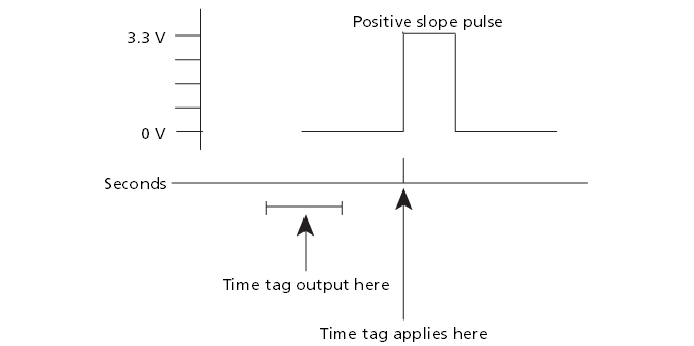
The pulse is about 8 microseconds wide (although this is adjustable), with rise and fall times of about 100 ns. Resolution is approximately 40 ns RMS. Factors such as signal tracking quality (which affect position-time computation quality) may limit accuracy. Additionally, cable length adds delay, which can be accounted for; each meter of cable adds a delay of about 2 ns to satellite signals and a corresponding delay in the 1PPS pulse.
Each time tag is output about 0.8 seconds before the corresponding pulse. Time tags are in ASCII format on a user-selected serial port. The format of a time tag is:
UTC yy.mm.dd hh:mm:ss ab
Where:
-
UTC is fixed text.
-
yy.mm.dd is the year, month, and date.
-
hh:mm:ss is the hour (on a 24-hour clock), minute, and second. The time is in UTC, not GPS.
-
a is an integer number representing the position-fix type:
1 = time solution only
2 = 1D position and time solution
3 = currently unused
4 = 2D position and time solution
5 = 3D position and time solution
-
b is the number of GNSS satellites being tracked. If the receiver is tracking nine or more satellites, b will always be displayed as 9.
-
Each time tag is terminated by a carriage return, line feed sequence. A typical printout looks like:
UTC 02.12.21 20:21:16 56
UTC 02.12.21 20:21:17 56
UTC 02.12.21 20:21:18 56
NOTE – If the receiver is not tracking satellites, the time tag is based on the receiver clock. In this case, a and b are represented by “??”. The time readings from the receiver clock are less accurate than time readings determined from the satellite signals.
NOTE – During power-up, the output from the integrated circuit can be in an indeterminate state and a 1PPS pulse may be observed. It is recommended that systems be designed to ignore a 1PPS pulse if a corresponding 1PPS ASCII time tag has not been output before receiving a 1PPS pulse.
Also note that at power-up, the 1PPS ASCII time tag will begin to output once the clock is running, before setting time from the GNSS systems. Time will be output repeatedly as the start of GPS time (January 6,1980), appearing as follows:
-
UTC 80.01.06 00:00:00 ??
These 1PPS ASCII time tags should be ignored since the system has not yet set the time. No 1PPS pulse will be output during this time.
